A few percentage points may not look dramatic in a single year.
Over decades, compounding can make the difference enormous.
In this short CNBC interview, Tony Robbins discusses an example from The Holy Grail of Investing, comparing the historical performance he cites for private equity with the S&P 500.
Robbins points to a historical comparison of approximately 14.2% annually for private equity versus 9.2% for the S&P 500. This is not a comparison of multifamily real estate with stocks, nor is it a prediction of future returns. It is an interesting illustration of how seemingly modest differences in annual performance can compound over long periods of time.
The Power of Compounding
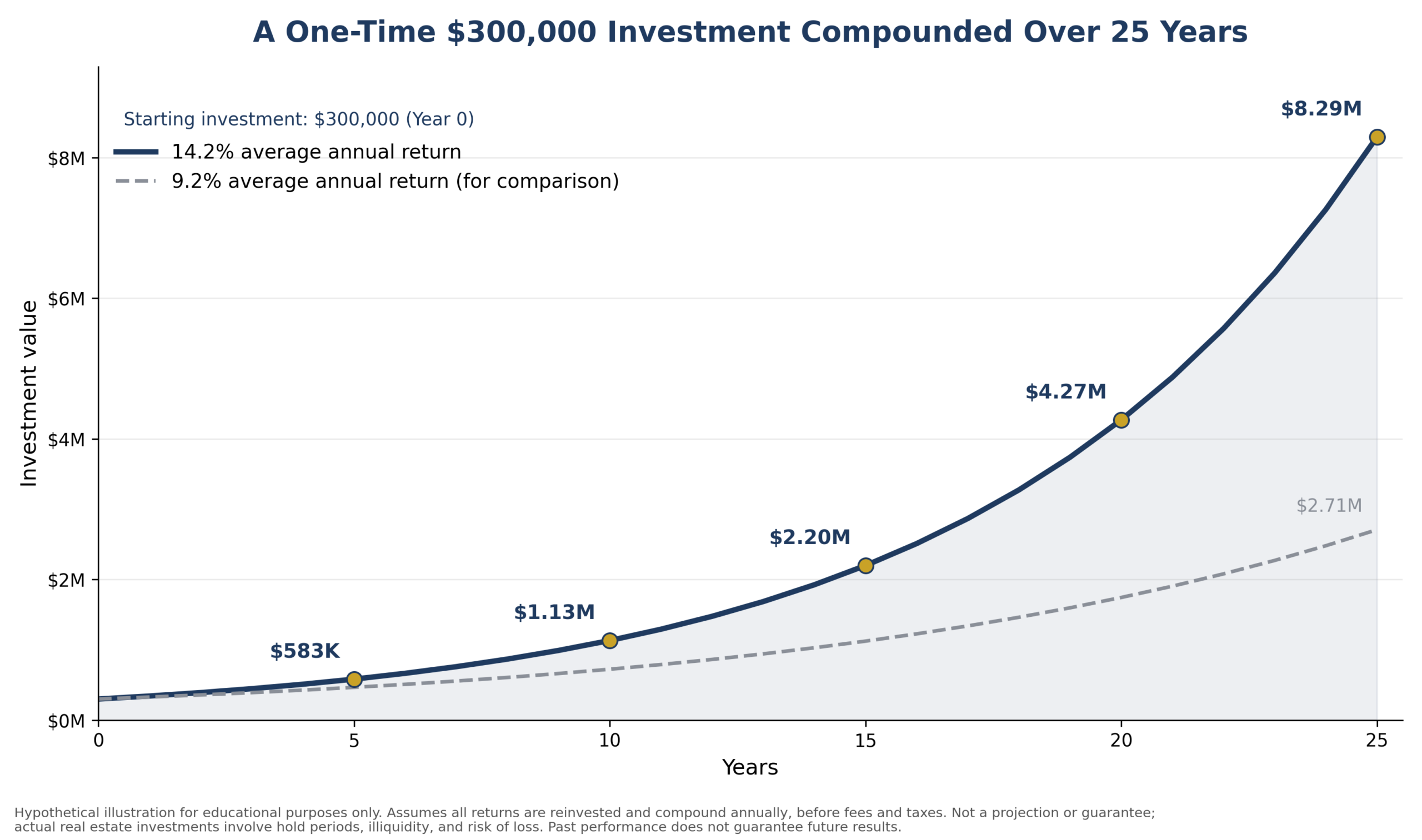
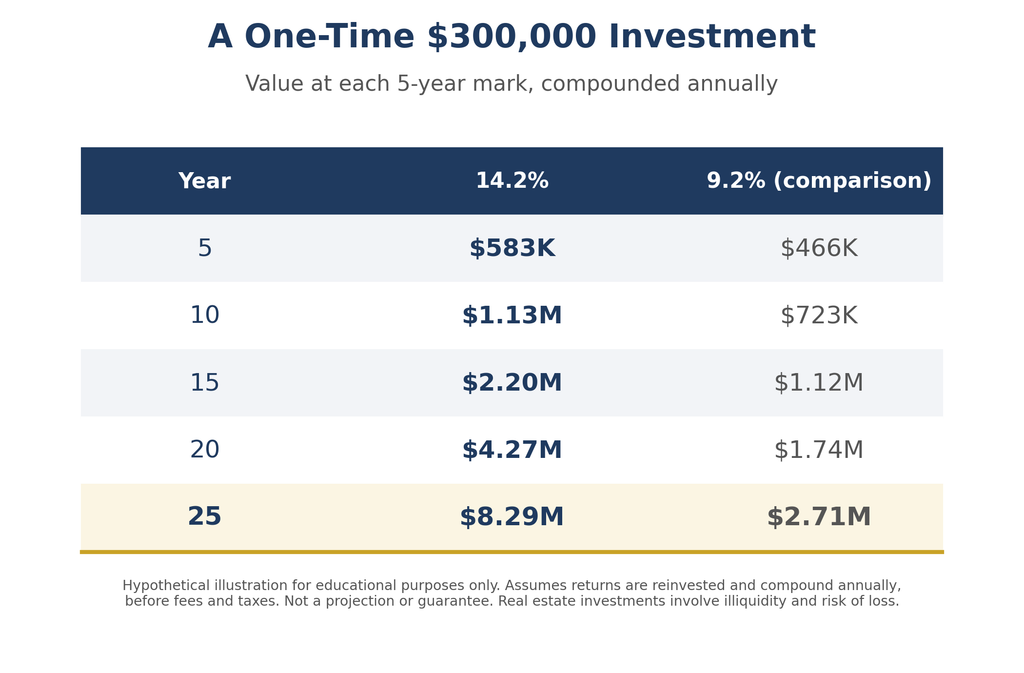
To visualize the difference, consider a hypothetical one-time investment of $300,000.
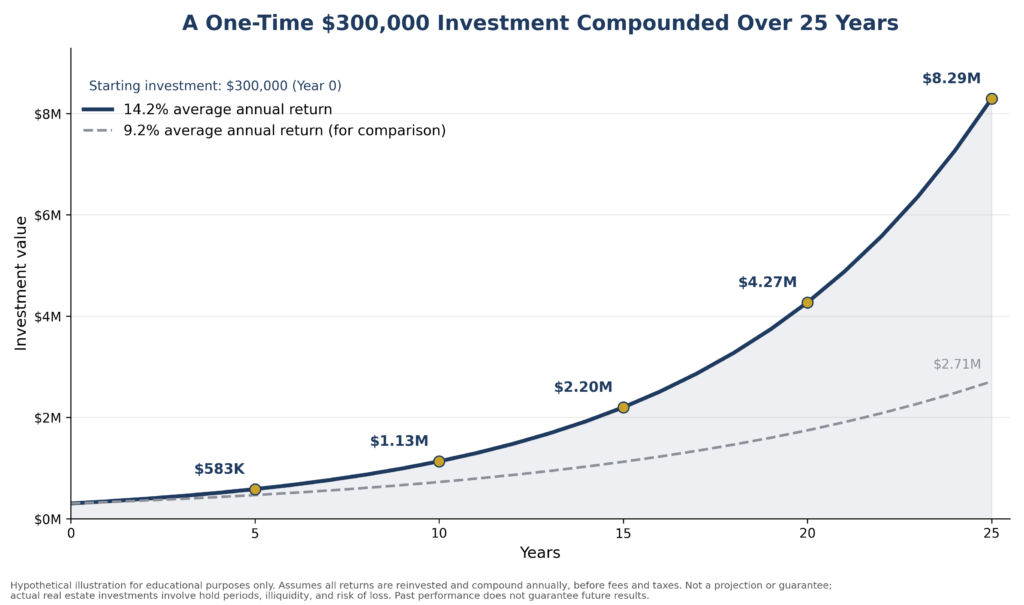
If $300,000 compounded annually at 14.2% for 25 years, it would grow to approximately $8.29 million.
At 9.2%, the same $300,000 would grow to approximately $2.71 million.
The point isn’t that an investor should expect either return.
It is that time magnifies differences in return.
That is one reason I believe investors should look beyond a headline percentage and think carefully about time horizon, risk, diversification, fees, taxes, liquidity, and the quality of the investment itself.
Compounding can be powerful.
But return is only one part of an investment decision.
Disclaimer
This illustration is hypothetical and is provided for educational and informational purposes only. It assumes annual compounding and reinvestment of returns and does not account for fees, taxes, distributions, timing of cash flows, or other investment expenses. The 14.2% and 9.2% figures referenced above relate to historical asset-class comparisons discussed by Tony Robbins and are not returns of Chateau Capital or any specific real estate investment. Past performance does not guarantee future results. Private equity, real estate, and other investments involve risk, including illiquidity and the possible loss of principal. Nothing presented here is investment, tax, legal, or accounting advice.
What Ray Kroc’s story can teach us about income, ownership, and building something that can continue producing when we cannot.
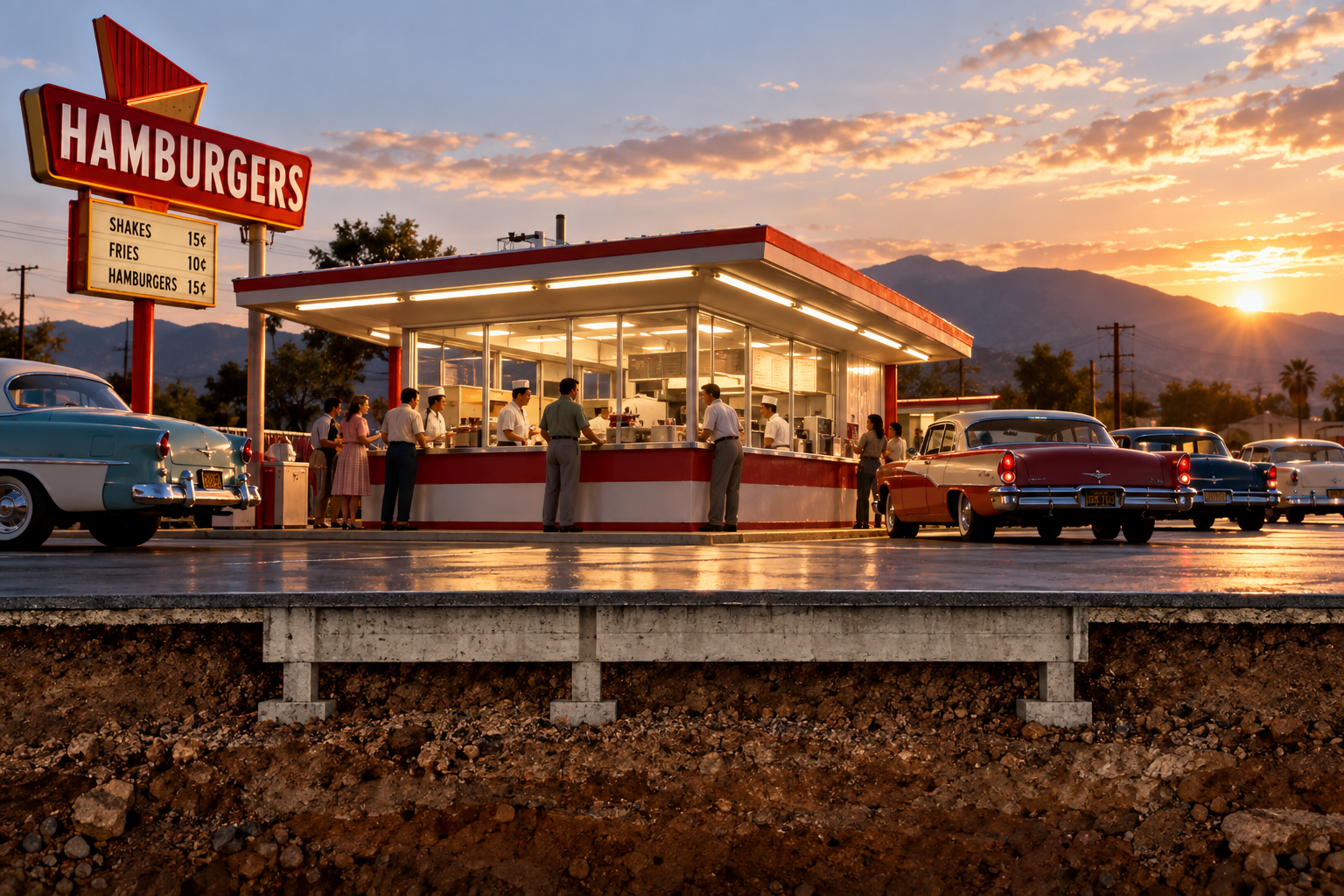
Picture a man climbing out of his car in a parking lot in San Bernardino, California. It is 1954. He is fifty-two years old.
His health is not particularly good. His finances are under pressure. He has spent decades selling everything from paper cups to milkshake mixers, and his current business is struggling.
This does not look like the beginning of his biggest chapter.
But one customer has caught his attention.
A small hamburger stand in San Bernardino has ordered eight of his five-spindle Multimixers—enough to make forty shakes at once. Ray Kroc wants to know what kind of restaurant needs that much capacity, so he drives out to see it for himself.
The stand belongs to brothers Dick and Mac McDonald.
Ray watches their system move with remarkable speed. Customers order, receive their food, and move on in a fraction of the time he is accustomed to seeing at other drive-ins.
What he sees is not simply a successful hamburger stand.
He sees a system that might be repeated.
The Opportunity Was Bigger Than the Hamburger
Ray eventually persuaded the McDonald brothers to let him franchise their system.
The opportunity was exciting.
The economics were not.
By 1959, McDonald’s had opened its hundredth restaurant, but Ray was still struggling to make the business model work. Franchise fees were thin, and growth alone was not solving the problem.
Then Harry Sonneborn, a finance executive, showed Ray another way to think about the company.
McDonald’s did not have to participate only in the restaurant business.
It could participate in the real estate beneath the restaurants.
The model was straightforward: acquire control of real estate at strong locations and lease it to franchisees. The franchisee operated the restaurant. McDonald’s collected rent along with its other franchise-related revenue.
That changed something fundamental.
The hamburger had not changed.
The source and structure of the company’s income had.
McDonald’s now had an asset base and recurring lease income that could help support future growth.
What ultimately changed the economics of the company was not simply a better hamburger.
It was ownership.
Storefront or Ground?
Think about a storefront.
It needs people behind the counter. Product has to be delivered. Employees have to be hired. Customers have to be served.
If everyone stops showing up, eventually the business stops producing.
Now think about the property beneath that business.
The sign can change.
The operator can change.
But ownership of a well-located productive asset can continue to have value and generate income beyond the labor of any one person.
That is the distinction I find so important.
The question is not literally storefront or land.
The question is:
Am I building only income that depends on me showing up—or am I also building ownership in assets that can continue producing when I am not there?
That is a very different way to think about wealth.
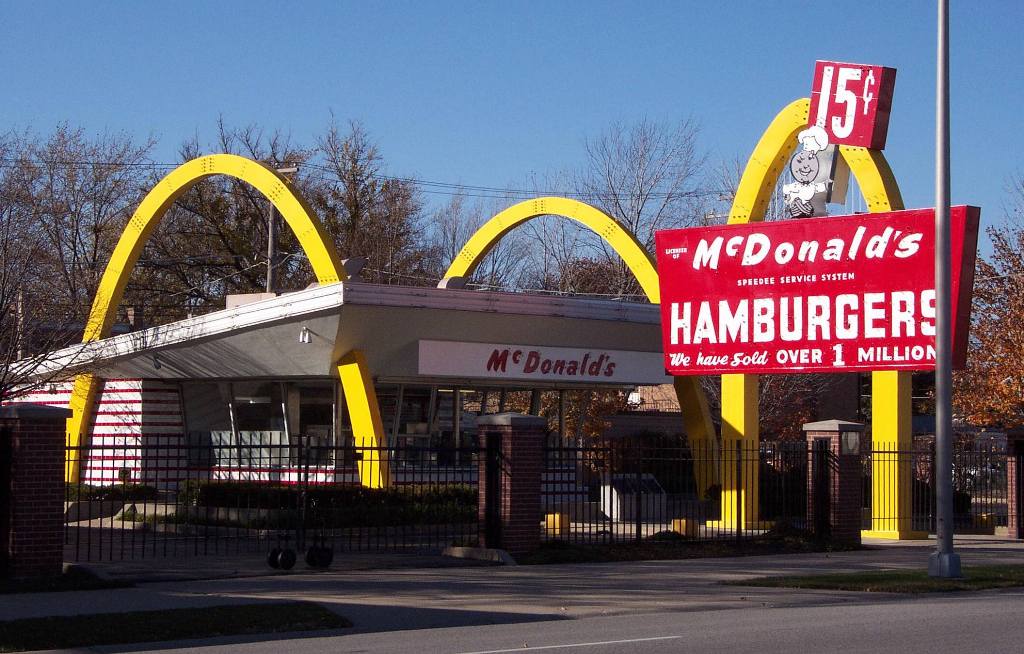
My first job, at fifteen, was on the burger line at the oldest McDonald’s in Winston-Salem.
Some nights I would clean every piece of equipment and call my dad at 3:15 in the morning for a ride home.
He was not quite as enthusiastic about that schedule as I was.
God bless my dad—a patient father of four and a truly great man.
Years later, the lesson behind Ray Kroc’s story resonated with me for another reason.
My parents were in ministry, and so was I for a season. We never had much money for stocks, but sometimes we could scrape together a down payment on a rental property.
Over time, renters helped pay down the mortgage.
Eventually, we owned property free and clear.
That was my first real lesson in income that did not depend entirely on the hours I personally worked.
Later, as a passive investor, I discovered that I could participate in professionally managed real estate without being the person handling every repair, resident call, or property-management decision.
The work did not disappear.
My role changed.
That distinction became part of the thinking behind my book, Earn More and Worry Less.
Passive Does Not Mean Nobody Works
This is an important point.
Passive investing does not mean nobody is doing the work.
Operators and property managers still have to manage the property, maintain the community, work with residents, control expenses, oversee renovations, manage financing, and execute the business plan.
The investor simply has a different role.
Investors provide capital and participate in the results.
That does not remove risk.
It makes diligence part of the investor’s job.
You still need to understand the deal, the operator, the market, the financing, the assumptions, and the reserves.
The goal is not “no work.”
The goal is to separate at least some of your income from your constant physical presence.
Why Multifamily Real Estate?
For me, one answer has been professionally managed multifamily real estate.
Not because apartments are magic.
And certainly not because they are risk-free.
Housing meets an enduring human need, and a professionally managed apartment community can generate recurring rental income without requiring every investor to operate the property personally.
But there is another part of this that matters to me.
Every unit on a spreadsheet is also someone’s home.
A nurse may be coming home from a double shift.
A young family may be saving for their first house.
A retiree may simply want a safe and comfortable community.
Good ownership therefore has responsibilities as well as potential returns.
That is one reason I believe evaluating the operator matters so much.
What Is the Freedom For?
Once you begin separating income from your constant physical labor, another question follows.
What do you want that freedom to make possible?
For Ray and Joan Kroc, wealth eventually supported philanthropy on an extraordinary scale.
After Ray died, Joan became a major philanthropist in her own right. Her giving ultimately supported public radio, The Salvation Army, and communities around the country.
The point is not that Ray Kroc envisioned every eventual use of that wealth while standing in a hamburger-stand parking lot in 1954.
He did not.
The point is that he helped build an enterprise capable of creating value beyond his own daily labor.
Joan later used that capacity in ways that reached people they would never meet.
That is the bridge between financial freedom and impact.
Recurring income does not automatically create purpose.
But it can expand what you are able to do with the purposes you already have.
Financial Strategy Can Serve Stewardship
So for me, the important question is not simply:
How much can I accumulate?
It is:
What could greater financial capacity make possible?
More time with family.
More freedom to serve.
More ability to give.
More room to take on work that matters, even when that work pays less.
That is where financial strategy can serve stewardship.
The money is not the purpose.
It can give you choices about where your time, energy, and resources go.
You Do Not Have to Build McDonald’s
Ray Kroc was fifty-two when he first visited the McDonald brothers’ restaurant.
He could not see the entire road ahead of him from that parking lot.
He recognized an opportunity, kept moving, and eventually learned a business model that reduced the dependence of the company’s income on his own labor.
You do not have to reproduce Ray Kroc’s outcome.
You do not have to build McDonald’s.
You do not even have to buy land.
But you can ask yourself whether all of your income will always depend on you showing up.
The first step does not have to be dramatic.
It may simply be learning how passive investing works, understanding the risks, deciding what role ownership could play in your financial life, and taking action only when an opportunity fits your goals and circumstances.
I will leave you with two questions.
What do you want greater freedom of time and resources to make possible in your life—and beyond it?
And:
Are you building only income that requires your continued presence, or are you also building ownership that can continue producing when you step away?
My hope is that whatever you choose to build gives you more than income.
I hope it gives you greater freedom to be present for the people you love, support the causes that matter to you, and create value that can continue beyond your own labor.
That, to me, is the real lesson of the land beneath the griddle.
If professionally managed multifamily real estate is something you want to understand better, ask me for the Passive Income Playbook. It explains how I think about passive investing, the role of the operator, and the questions an investor should ask before deciding whether a deal fits. If it makes sense for you, my team and I would be glad to continue the conversation.
How real estate can help families not just survive inflation, but harness it.
My kindergarten teacher once pulled my parents aside with an unusual observation. She said she’d rarely met a five-year-old who knew so much about budgets, inflation, and what it takes for a family to provide the basics.
She meant it as a compliment. My parents probably heard it as something closer to a confession.
We were a ministry family. My parents served people for a living, and their income came from the generosity of others. When prices rose, their paycheck didn’t. In fact, inflation often squeezed the people who gave to their ministry, so contributions sometimes shrank at the exact moment everything else cost more. With another baby on the way, our budget went from careful to tight to downright anxious. I didn’t learn the word “inflation” from a textbook. I learned it from watching my parents’ faces at the kitchen table and before bed.
When the Wind Changed Direction
Then something remarkable happened. Through a few gifts I can only describe as miraculous, my parents came to own some real estate.
Slowly, I watched inflation change sides. The same force that had shrunk our grocery budget now lifted property values. Rents rose over time, and that income helped my parents keep pace with rising costs instead of falling further behind. Inflation hadn’t stopped. It had simply started working for us instead of against us, at the very least WITH us.
I’ve thought about that ever since, especially for the people who feel inflation most and can do the least about it: ministers, teachers, law enforcement officers, public servants, hourly workers, and retirees on fixed incomes. Many of them never receive a meaningful cost-of-living adjustment. Every year, their dollar buys a little less, and nobody sends them a notice.
That is one reason that some apartment communities set aside a portion of their apartments for ministers, teachers, law enforcement, more modest income workers.
Inflation Is Wind. Real Estate Can Be a Kite.
Here’s the simplest way I know to explain it.
Inflation is like wind. You can’t stop it, and you can’t vote it away. If you’re holding cash or living on a fixed income, that wind blows directly into your face, and it pushes you backward.
But a well-built kite doesn’t fight the wind. It uses it. And well-owned real estate can work the same way, through four parts of the kite.
The sail: rents that can adjust. Most apartment leases run about twelve months. When the cost of living rises, rents can reset over time to reflect it. That’s the sail catching the wind. It doesn’t adjust perfectly or instantly, and it never rises forever, but it can rise.
The string: fixed-rate debt. A kite needs a strong string, anchored firmly. In real estate, that string is long-term, fixed-rate financing. The loan payment stays the same, even as rents and prices rise. Over time, inflation shrinks the real weight of that debt, and more of each rent dollar stays with the owners. Variable debt can kill worse than inflation – avoid it.
A warning here, because I’ve seen what happens without it: floating-rate debt is a string that stretches when the wind blows hardest. From 2008 to 2010, and again in 2022 through 2024, many investors learned that lesson painfully. A good kite with a weak string ends up in a tree.
The builder’s hand: forced appreciation. Some value depends on the market. Some value an owner creates. We call that forced appreciation: renovating tired units, improving management, cutting waste, and making a community a place residents want to stay.
Because apartment values are tied to the income a property produces, every dollar of added income can raise its value, whether or not the market helps. That’s the builder reshaping the kite to fly higher in any wind.
The design: tax advantages. Real estate is one of the few investments the tax code actively encourages. Depreciation lets owners deduct the wear and tear on a building, even as it may be rising in value. Since July 2025, 100% bonus depreciation has been permanently restored for qualifying property. Combined with a cost segregation study, it can accelerate years of those deductions into the early years of ownership. For many investors, a large share of their distributions can be sheltered from current taxes.
It’s important to be accurate here. Depreciation generally defers taxes rather than eliminating them, and for most passive investors, the losses on their K-1 offset other passive income, not their salaries. Every investor’s situation is different, which is why we always encourage working with a qualified CPA. But the principle holds: more capital stays working, and less goes to taxes along the way.
Flying more than one kite. One kite can be caught by a sudden gust. Several kites, in different fields and flown at different times, give you steadier lift. That’s how I think about diversification: different properties, different markets, different years.
The Tribe That Taught Me the Other Side
Later in life I discovered a group of people I hadn’t known existed: private money lenders. Some are called hard money lenders, and over time I learned the difference. They lend against real estate, and I borrowed from them to grow.
Over the years, something moved me deeply. The interest I paid them became the income some of them lived on, especially when health challenges came or they needed to slow down. Real estate had become their paycheck.
That’s when my childhood question became my life’s work. How could I bring real estate’s benefits, including equity growth, rising rents, and tax advantages, to more people?
What We Do Today
Today, through Chateau Capital, we invite accredited investors to own shares in apartment communities alongside us. They receive the benefits of real estate ownership without fixing toilets or chasing rent. And their capital does something good along the way: it provides housing, and ideally homes that residents love.
I’ll never forget what inflation did to my parents, or what real estate eventually did for them. Inflation will always blow. The question is whether you’re standing in the wind, or flying a kite.
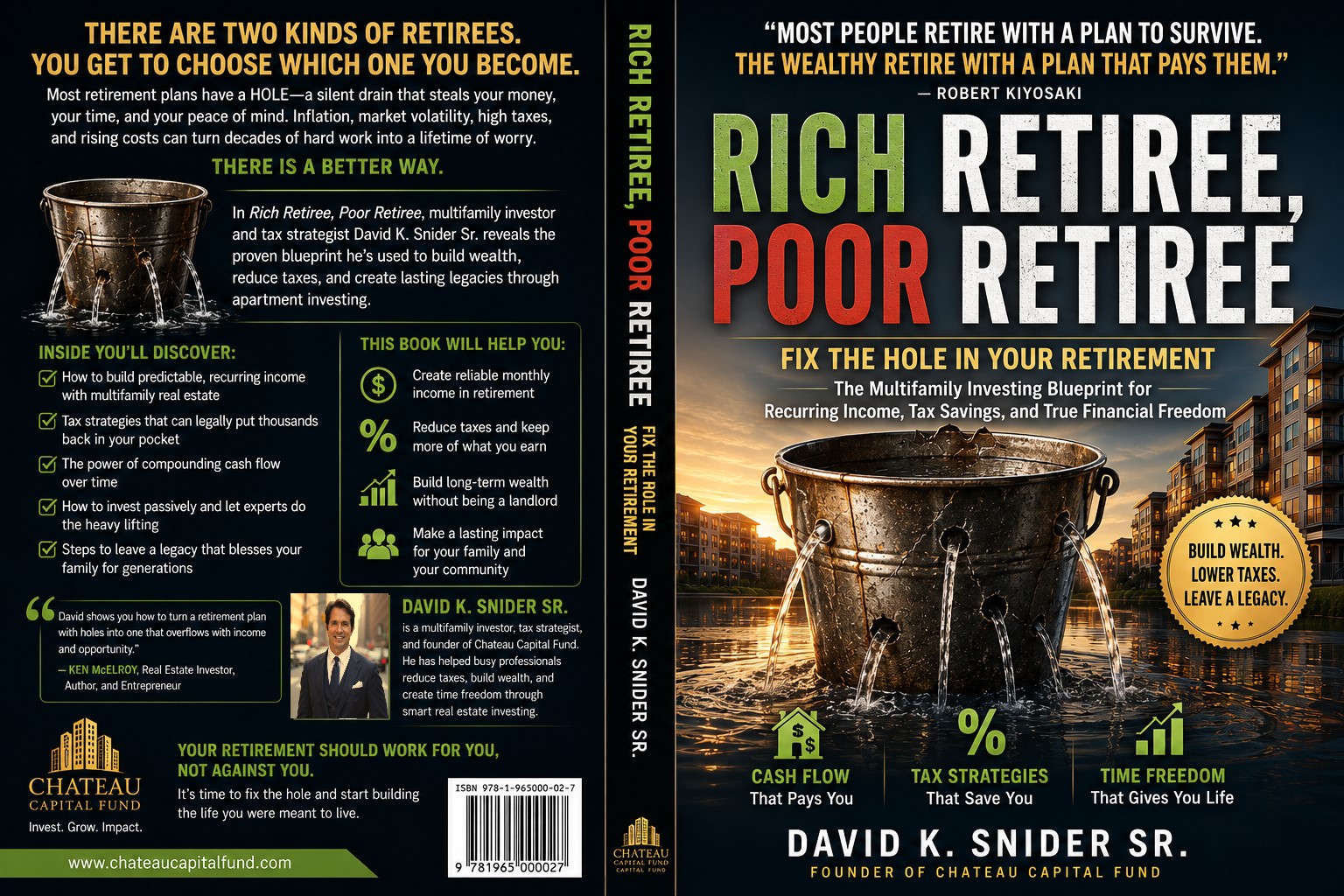
If you’d like to learn more about how passive real estate investing works, [download my free eBook, Rich Retiree, Poor Retiree] or [schedule a conversation with me].
This article is for educational purposes only and is not tax, legal, or investment advice. Investments in real estate involve risk, including loss of principal. Consult your own tax advisor about your situation.
Sample section of the book is below. If you’d like to read the entire ebook please click here.
Meet the Retirees
Two people. Two portfolios. One difference that changes everything.
Richard and Tom worked similar careers, made similar incomes, and retired within a year of each other. Both did what they were told: max out the retirement accounts, diversify, stay the course. On paper, at sixty-five, they looked almost identical.
Ten years later, they don’t.
Richard checks his portfolio balance most mornings. Not because he’s doing anything wrong, but because his retirement depends on what that balance can continue to support. Every withdrawal raises the same questions: How much is safe to spend? How long will it last? His plan has a built-in countdown, whether he wants to watch it or not.
To read more please enter your email address and we will send you the complete ebook.