Author: Dave Snider

  • What a 5% Difference in Annual Returns Can Mean Over Time

    What a 5% Difference in Annual Returns Can Mean Over Time

    A few percentage points may not look dramatic in a single year.

    Over decades, compounding can make the difference enormous.

    In this short CNBC interview, Tony Robbins discusses an example from The Holy Grail of Investing, comparing the historical performance he cites for private equity with the S&P 500.

    Robbins points to a historical comparison of approximately 14.2% annually for private equity versus 9.2% for the S&P 500. This is not a comparison of multifamily real estate with stocks, nor is it a prediction of future returns. It is an interesting illustration of how seemingly modest differences in annual performance can compound over long periods of time.

    The Power of Compounding

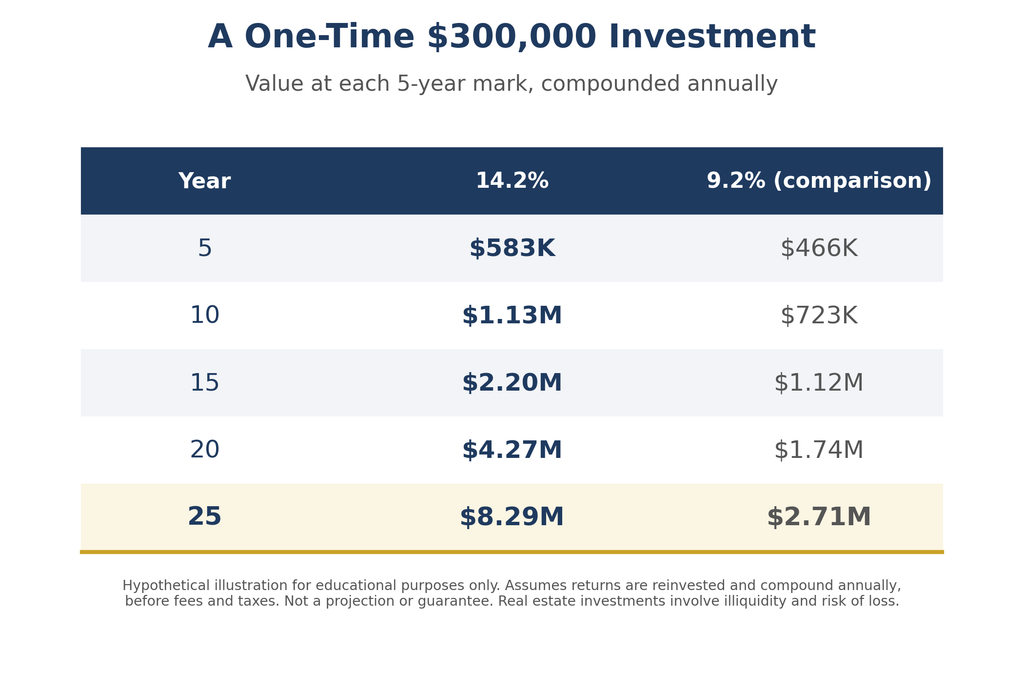
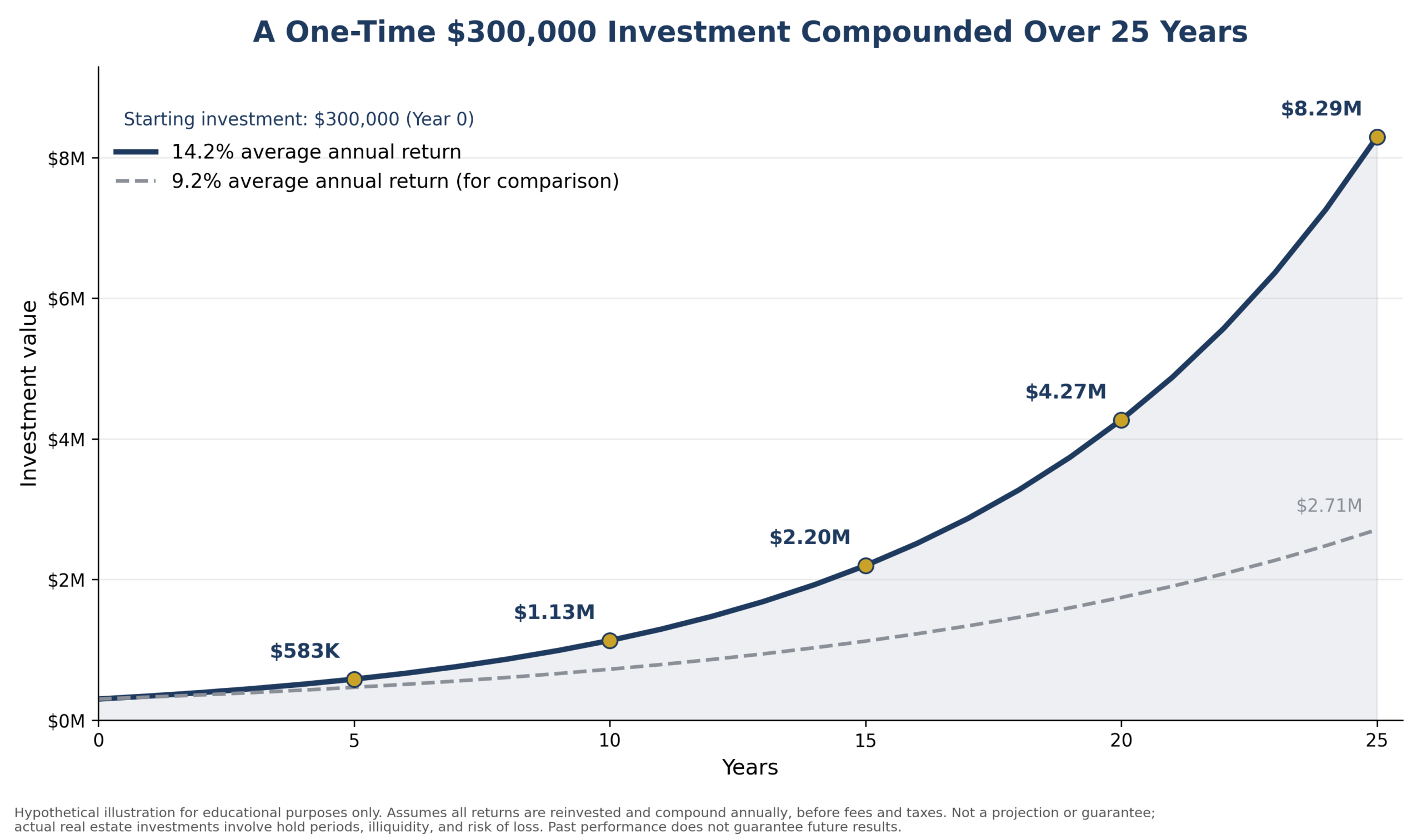
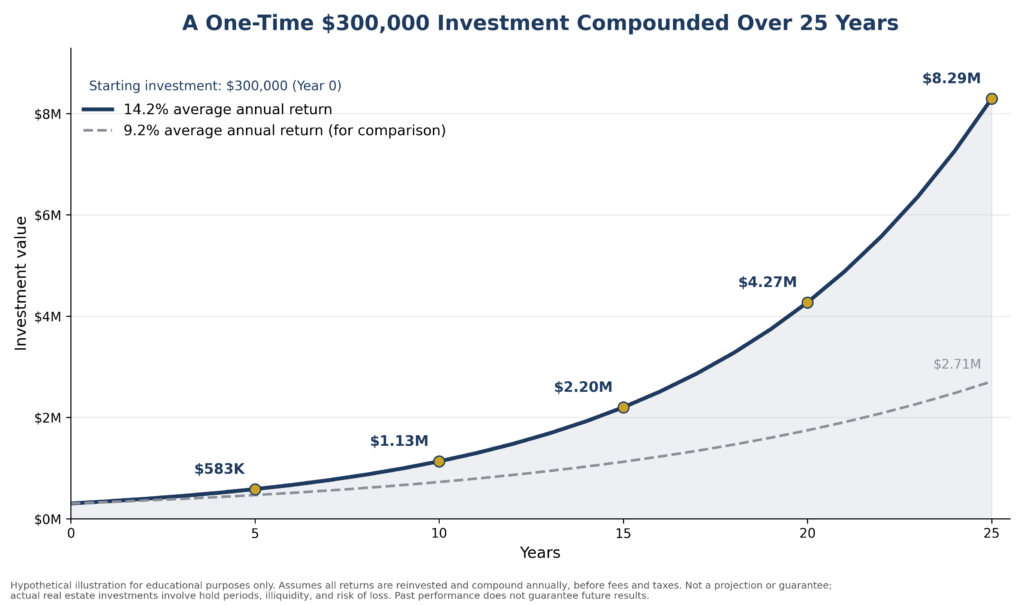
    To visualize the difference, consider a hypothetical one-time investment of $300,000.

    If $300,000 compounded annually at 14.2% for 25 years, it would grow to approximately $8.29 million.

    At 9.2%, the same $300,000 would grow to approximately $2.71 million.

    The point isn’t that an investor should expect either return.

    It is that time magnifies differences in return.

    That is one reason I believe investors should look beyond a headline percentage and think carefully about time horizon, risk, diversification, fees, taxes, liquidity, and the quality of the investment itself.

    Compounding can be powerful.

    But return is only one part of an investment decision.


    Disclaimer

    This illustration is hypothetical and is provided for educational and informational purposes only. It assumes annual compounding and reinvestment of returns and does not account for fees, taxes, distributions, timing of cash flows, or other investment expenses. The 14.2% and 9.2% figures referenced above relate to historical asset-class comparisons discussed by Tony Robbins and are not returns of Chateau Capital or any specific real estate investment. Past performance does not guarantee future results. Private equity, real estate, and other investments involve risk, including illiquidity and the possible loss of principal. Nothing presented here is investment, tax, legal, or accounting advice.

  • The Land Beneath the Griddle

    The Land Beneath the Griddle

    What Ray Kroc’s story can teach us about income, ownership, and building something that can continue producing when we cannot.

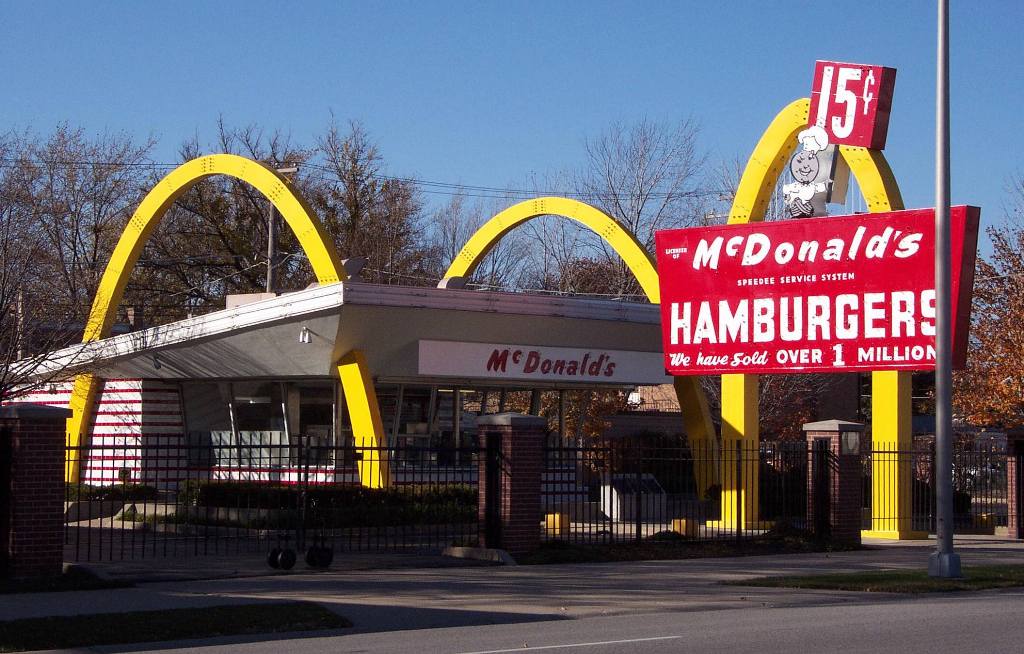
    Picture a man climbing out of his car in a parking lot in San Bernardino, California. It is 1954. He is fifty-two years old.

    His health is not particularly good. His finances are under pressure. He has spent decades selling everything from paper cups to milkshake mixers, and his current business is struggling.

    This does not look like the beginning of his biggest chapter.

    But one customer has caught his attention.

    A small hamburger stand in San Bernardino has ordered eight of his five-spindle Multimixers—enough to make forty shakes at once. Ray Kroc wants to know what kind of restaurant needs that much capacity, so he drives out to see it for himself.

    The stand belongs to brothers Dick and Mac McDonald.

    Ray watches their system move with remarkable speed. Customers order, receive their food, and move on in a fraction of the time he is accustomed to seeing at other drive-ins.

    What he sees is not simply a successful hamburger stand.

    He sees a system that might be repeated.

    The Opportunity Was Bigger Than the Hamburger

    Ray eventually persuaded the McDonald brothers to let him franchise their system.

    The opportunity was exciting.

    The economics were not.

    By 1959, McDonald’s had opened its hundredth restaurant, but Ray was still struggling to make the business model work. Franchise fees were thin, and growth alone was not solving the problem.

    Then Harry Sonneborn, a finance executive, showed Ray another way to think about the company.

    McDonald’s did not have to participate only in the restaurant business.

    It could participate in the real estate beneath the restaurants.

    The model was straightforward: acquire control of real estate at strong locations and lease it to franchisees. The franchisee operated the restaurant. McDonald’s collected rent along with its other franchise-related revenue.

    That changed something fundamental.

    The hamburger had not changed.

    The source and structure of the company’s income had.

    McDonald’s now had an asset base and recurring lease income that could help support future growth.

    What ultimately changed the economics of the company was not simply a better hamburger.

    It was ownership.

    Storefront or Ground?

    Think about a storefront.

    It needs people behind the counter. Product has to be delivered. Employees have to be hired. Customers have to be served.

    If everyone stops showing up, eventually the business stops producing.

    Now think about the property beneath that business.

    The sign can change.

    The operator can change.

    But ownership of a well-located productive asset can continue to have value and generate income beyond the labor of any one person.

    That is the distinction I find so important.

    The question is not literally storefront or land.

    The question is:

    Am I building only income that depends on me showing up—or am I also building ownership in assets that can continue producing when I am not there?

    That is a very different way to think about wealth.

    Attribution: By Bruce Marlin – Own work, CC BY-SA 2.5, https://commons.wikimedia.org/w/index.php?curid=1554191

    I Learned a Version of This Much Earlier

    My first job, at fifteen, was on the burger line at the oldest McDonald’s in Winston-Salem.

    Some nights I would clean every piece of equipment and call my dad at 3:15 in the morning for a ride home.

    He was not quite as enthusiastic about that schedule as I was.

    God bless my dad—a patient father of four and a truly great man.

    Years later, the lesson behind Ray Kroc’s story resonated with me for another reason.

    My parents were in ministry, and so was I for a season. We never had much money for stocks, but sometimes we could scrape together a down payment on a rental property.

    Over time, renters helped pay down the mortgage.

    Eventually, we owned property free and clear.

    That was my first real lesson in income that did not depend entirely on the hours I personally worked.

    Later, as a passive investor, I discovered that I could participate in professionally managed real estate without being the person handling every repair, resident call, or property-management decision.

    The work did not disappear.

    My role changed.

    That distinction became part of the thinking behind my book, Earn More and Worry Less.

    Passive Does Not Mean Nobody Works

    This is an important point.

    Passive investing does not mean nobody is doing the work.

    Operators and property managers still have to manage the property, maintain the community, work with residents, control expenses, oversee renovations, manage financing, and execute the business plan.

    The investor simply has a different role.

    Investors provide capital and participate in the results.

    That does not remove risk.

    It makes diligence part of the investor’s job.

    You still need to understand the deal, the operator, the market, the financing, the assumptions, and the reserves.

    The goal is not “no work.”

    The goal is to separate at least some of your income from your constant physical presence.

    Why Multifamily Real Estate?

    For me, one answer has been professionally managed multifamily real estate.

    Not because apartments are magic.

    And certainly not because they are risk-free.

    Housing meets an enduring human need, and a professionally managed apartment community can generate recurring rental income without requiring every investor to operate the property personally.

    But there is another part of this that matters to me.

    Every unit on a spreadsheet is also someone’s home.

    A nurse may be coming home from a double shift.

    A young family may be saving for their first house.

    A retiree may simply want a safe and comfortable community.

    Good ownership therefore has responsibilities as well as potential returns.

    That is one reason I believe evaluating the operator matters so much.

    What Is the Freedom For?

    Once you begin separating income from your constant physical labor, another question follows.

    What do you want that freedom to make possible?

    For Ray and Joan Kroc, wealth eventually supported philanthropy on an extraordinary scale.

    After Ray died, Joan became a major philanthropist in her own right. Her giving ultimately supported public radio, The Salvation Army, and communities around the country.

    The point is not that Ray Kroc envisioned every eventual use of that wealth while standing in a hamburger-stand parking lot in 1954.

    He did not.

    The point is that he helped build an enterprise capable of creating value beyond his own daily labor.

    Joan later used that capacity in ways that reached people they would never meet.

    That is the bridge between financial freedom and impact.

    Recurring income does not automatically create purpose.

    But it can expand what you are able to do with the purposes you already have.

    Financial Strategy Can Serve Stewardship

    So for me, the important question is not simply:

    How much can I accumulate?

    It is:

    What could greater financial capacity make possible?

    More time with family.

    More freedom to serve.

    More ability to give.

    More room to take on work that matters, even when that work pays less.

    That is where financial strategy can serve stewardship.

    The money is not the purpose.

    It can give you choices about where your time, energy, and resources go.

    You Do Not Have to Build McDonald’s

    Ray Kroc was fifty-two when he first visited the McDonald brothers’ restaurant.

    He could not see the entire road ahead of him from that parking lot.

    He recognized an opportunity, kept moving, and eventually learned a business model that reduced the dependence of the company’s income on his own labor.

    You do not have to reproduce Ray Kroc’s outcome.

    You do not have to build McDonald’s.

    You do not even have to buy land.

    But you can ask yourself whether all of your income will always depend on you showing up.

    The first step does not have to be dramatic.

    It may simply be learning how passive investing works, understanding the risks, deciding what role ownership could play in your financial life, and taking action only when an opportunity fits your goals and circumstances.

    I will leave you with two questions.

    What do you want greater freedom of time and resources to make possible in your life—and beyond it?

    And:

    Are you building only income that requires your continued presence, or are you also building ownership that can continue producing when you step away?

    My hope is that whatever you choose to build gives you more than income.

    I hope it gives you greater freedom to be present for the people you love, support the causes that matter to you, and create value that can continue beyond your own labor.

    That, to me, is the real lesson of the land beneath the griddle.

    If professionally managed multifamily real estate is something you want to understand better, ask me for the Passive Income Playbook. It explains how I think about passive investing, the role of the operator, and the questions an investor should ask before deciding whether a deal fits. If it makes sense for you, my team and I would be glad to continue the conversation.

  • Inflation Taught Me Economics at Age Five. Real Estate Taught Me How to Fly a Kite.

    Inflation Taught Me Economics at Age Five. Real Estate Taught Me How to Fly a Kite.

    How real estate can help families not just survive inflation but harness it.

    My kindergarten teacher once pulled my parents aside with an unusual observation. She said she’d rarely met a five-year-old who knew so much about budgets, inflation, and what it takes for a family to provide the basics.

    She meant it as a compliment. My parents probably heard it as something closer to a confession.

    We were a ministry family.  My parents served people for a living, and their income came from the generosity of others.  When prices rose, their paycheck didn’t.  In fact, inflation often squeezed the people who gave to their ministry, so contributions sometimes shrank at the exact moment everything else cost more.  With another baby on the way (sibling 3), our budget went from careful to tight to downright anxious for Mom.  I didn’t learn the word “inflation” from a textbook.  I learned it from watching my parents’ faces at the kitchen table and before bed.  Ministry was the important calling they pledged their lives to.  

    When the Wind Changed Direction

    Then something remarkable happened.  Through a few gifts I can only describe as miraculous, my parents came to own some real estate.  We switched from renting and fixing fixer-upper’s to owning one, then more.  

    Slowly, I watched inflation change sides.  The same force that had shrunk our grocery budget now lifted property values.  Rents rose over time, and that income helped my parents keep pace with rising costs instead of falling further behind.  Inflation hadn’t stopped.  It had simply started working for us instead of against us.

    Real estate helped my family (and others) stay in ministry and educator roles, impacting many people positively, with recurring IMPACT.  I saw real estate help missionaries in similar ways.  Additionally, I saw professionals support causes and ministries they cared about even during inflationary times.  

    I’ve thought about that ever since, especially for the people who feel inflation most and can do the least about it: ministers, teachers, law enforcement officers, public servants, hourly workers, and retirees on fixed incomes.  Many of them never receive a meaningful cost-of-living adjustment.  Every year, their dollar buys a little less, and nobody sends them a notice.  That is one reason that some apartment communities set aside a portion of their apartments for modest income workers and professionals (such as ministers, teachers, and law enforcement).

    Inflation Is Wind. Real Estate Can Be a Wright Brothers Kite.

    Here’s the simplest way I know to explain it.

    Inflation is like wind.  You can’t stop it, and you can’t vote it away.  If you’re holding cash or living on a fixed income, that wind blows directly into your face, and it pushes you backward.

    But a well-built kite like the bicycle shop Wright brothers built doesn’t fight the wind.  It uses it.  And well-owned real estate can work the same way, through four parts of the kite.

    1. The sail: rents that can adjust.  Most apartment leases run about twelve months.  When the cost of living rises, rents can reset over time to reflect it.  That’s the sail (or wing) catching the wind.  It doesn’t adjust perfectly or instantly, and it never rises forever, but it can rise.  I learned that real estate could create recurring income, even when the owners were working at other causes, meeting other needs.  Recurring impact followed. 
    2. The string: fixed-rate debt.  A kite needs a strong string, anchored firmly.  In real estate, that string is long-term, fixed-rate financing.  America has these more than other countries.  The loan payment stays the same, even as rents and prices rise.  Over time, inflation shrinks the real weight of that debt, and more of each rent dollar stays with the owners.  Variable debt can kill worse than inflation – avoid it.  

      A warning here, because I’ve seen what happens without it: floating-rate debt is a string that stretches when the wind blows hardest.  From 2008 to 2010, and again in 2020 through 2024, many investors learned that lesson painfully.  A good kite with a weak string ends up in a tree.  It may not survive well.  
    3. The builder’s hand: forced appreciation.  Some value depends on the market.  Some value an owner creates.  We call that forced appreciation: renovating tired units, improving management, cutting waste, and making a community a place residents want to stay.   Because apartment values are tied to the income a property produces, every dollar of added income can raise its value, whether or not the market helps.  That’s the builder reshaping the kite (or plane) to fly higher in any wind.
    4. The design: tax advantages.  Real estate is one of the few investments the tax code actively encourages.  INCENTIVE: Depreciation lets owners deduct the wear and tear on a building, even as it may be rising in value.  Since July 2025, 100% bonus depreciation has been permanently restored for qualifying property.  Combined with a cost segregation study, depreciation can accelerate years of those deductions into the early years of ownership.  For many investors, a large share of their distributions can be sheltered from current taxes. 

      It’s important to be accurate here.  Depreciation generally defers taxes rather than eliminating them, and for most passive investors, the losses on their K-1 offset other passive income, not their salaries.  Every investor’s situation is different, which is why we always encourage working with a qualified experienced CPA.  But the principle holds: more capital stays working, and less goes to taxes along the way.  (explanation at end of this article) 
    5. Flying more than one kite.  One kite can be caught by a sudden gust.  Several kites, in different fields and flown at different times, give you steadier lift.  The Wright brothers used Left and Right Wings.  That’s how I think about diversification: different properties, different markets, different years.

    The Tribe That Taught Me the Other Side

    Later in life I discovered a group of people I hadn’t known existed: private money lenders, economic partners, equity partners.  Some are called hard money lenders, and over time I learned the difference. They lend against real estate, and I borrowed from them to grow.  Some contribute to the equity and capture equity growth and distributions.  

    Over the years, something moved me deeply.  The interest I paid them became the income many of them lived on, especially when health challenges came or they needed to slow down.  Real estate distributions had become their monthly paychecks.  I saw how it could benefit others.  (this is why I wrote EARN MORE WORRY LESS)

    That’s when my childhood question became my life’s work to help create positive impact on causes my parents and I care about.  How could I bring real estate’s benefits, including equity growth, rising rents, and tax advantages, to more people?  How could it help missions, missionaries, and more ministries, while I’m alive, and beyond?  

    What We Do Today

    Today, through Chateau Capital, we invite accredited investors to own shares in apartment communities alongside us.  They receive the benefits of real estate ownership without fixing toilets or chasing rent.  And their capital does something good along the way: it provides housing, and ideally homes that residents love.

    I’ll never forget what inflation did to my parents, or what real estate eventually did for them. Inflation will always blow.  The question is whether you’re standing in the wind, or flying kites to let the wind propel your kites.

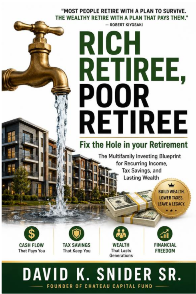
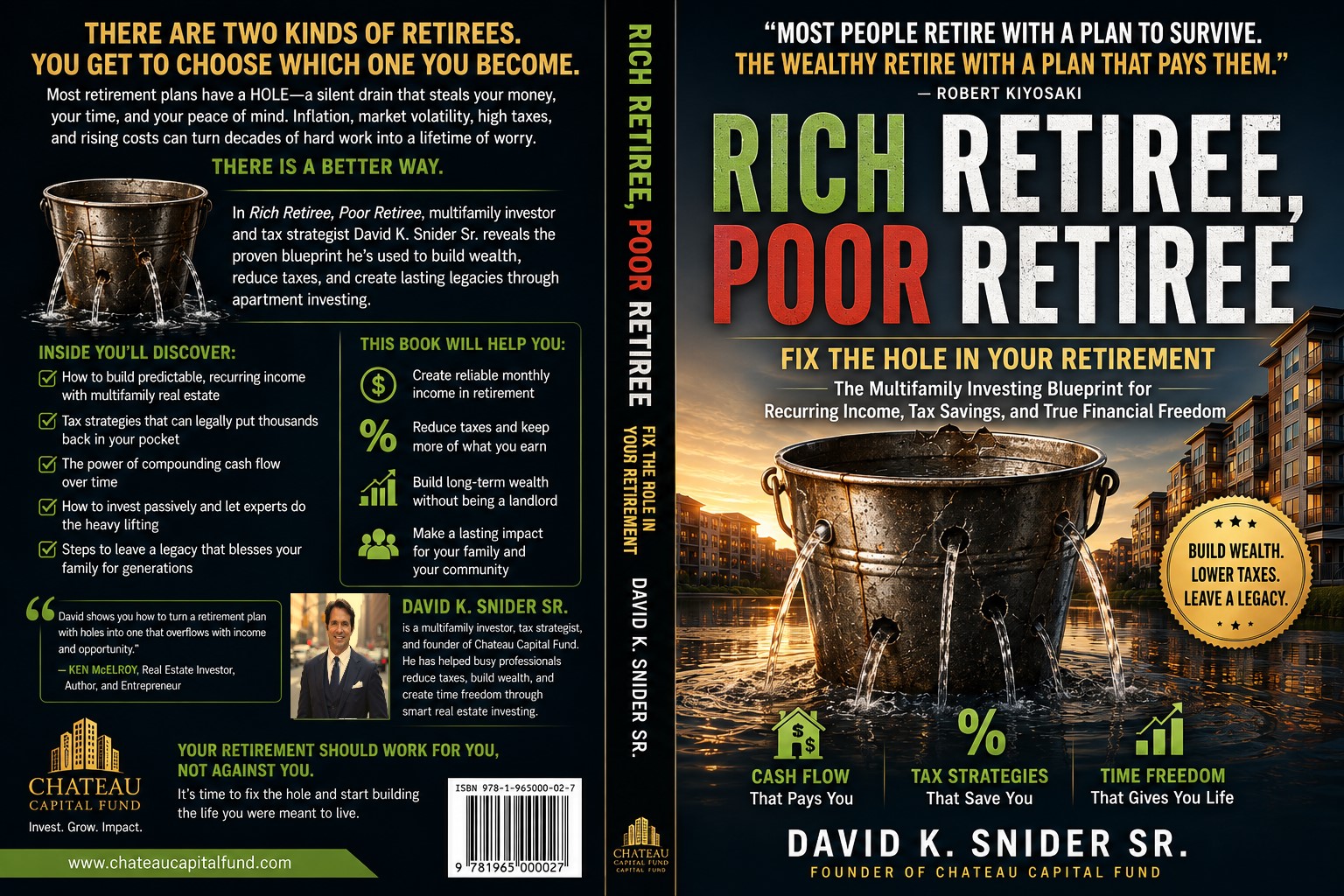
    If you’d like to learn more about how passive real estate investing works, [download my free eBook, Rich Retiree, Poor Retiree] or [schedule a conversation with me].

    This article is for educational purposes only and is not tax, legal, or investment advice. Investments in real estate involve risk, including loss of principal. Consult your own tax advisor about your situation.  No projections are shared, no offering is made in this article.  

    (The One Big Beautiful Bill Act’s reinstatement of 100% bonus depreciation explained here below – the WHY) 

    Congress enacted this permanent full expensing 100% bonus depreciation) model based on several core economic and societal arguments championed by tax policy experts and lawmakers:

    1. Incentivizing Housing Development and Modernization

    By allowing multi-family and rental housing investors to write off 100% of asset improvements in the very first year, the tax code heavily incentivizes capital investments. Landlords and developers are financially motivated to modernize aging apartment complexes, replace inefficient appliances, upgrade HVAC systems, and improve community infrastructure. This directly aids in preserving and expanding the quality of the nation’s housing stock.

    2. Boosting Worker Productivity and Wage Growth

    According to economic analyses from organizations like the Tax Foundation, delaying depreciation deductions creates an artificial penalty on business investments. Allowing immediate full expensing encourages companies to purchase newer, safer, and more efficient equipment. Over the long term, high volumes of capital investment boost overall worker productivity, which historically correlates with higher wages and broader job creation.

    3. Enhancing Cash Flow and Eliminating Economic Distortion

    Traditional depreciation forces property owners to spread tax deductions out over 5 to 15 years for minor improvements, which diminishes the real value of the write-off due to inflation. Restoring the deduction to 100% dramatically improves near-term cash flow for property owners. This provides immediate liquidity that can be reinvested directly back into local service providers, contractors, and local supply chains.

    4. Establishing Long-Term Regulatory Certainty

    The rolling expiration dates and annual phase-downs of previous tax codes caused immense friction for long-term business planning. Making the 100% bonus depreciation permanent removes the panic of a “sunset clause,” allowing construction companies, real estate developers, and agricultural producers to map out major capital projects years in advance without worrying about shifting tax goalposts.

  • Learning to See What Others Walk Past

    Learning to See What Others Walk Past

    The best opportunities aren’t always the ones that look the best. Sometimes they’re the ones you understand better than everyone else.

    Over the past few weeks, I’ve shared several stories from growing up.

    Fixing homes alongside my father.

    Learning about foundations and construction from my uncle, who was a mason.

    Watching my parents take a moisture-ridden lake cabin that needed plenty of work and slowly turn it into a place our family actually wanted to spend time.

    At the time, none of those experiences felt like lessons in investing.

    They were simply part of life.

    We weren’t sitting around the dinner table discussing value-add strategies or analyzing investment returns.

    When something was broken, we figured out whether it could be fixed.

    When something needed work, we did the work.

    And when we didn’t have much money to throw at a problem, we became resourceful.

    Looking back, though, I can see that those experiences were teaching me something much more valuable than how to repair a house.

    They were teaching me how to evaluate potential.

    And there’s a big difference between seeing potential and simply being optimistic.

    The Question Most People Ask

    When we encounter something that isn’t working, our natural instinct is to ask:

    “What’s wrong with it?”

    That’s a perfectly reasonable question.

    In real estate, it’s an essential one.

    What’s wrong with the roof?

    What’s wrong with the plumbing?

    Why is occupancy lower than comparable properties?

    Why are expenses higher?

    Why aren’t residents renewing?

    Why hasn’t the property performed the way ownership expected?

    But over time, I’ve realized that identifying the problem is only the beginning.

    The more useful question is:

    “What’s wrong with this—and is it actually fixable?”

    And then comes an even more important question:

    “Who is going to fix it?”

    Those questions sound simple.

    But they’re at the heart of how I think about opportunity.

    Not Every Problem is an Opportunity

    One of the mistakes investors can make is assuming that because something is distressed, it’s automatically undervalued. It isn’t. Sometimes a bad property is simply a bad property.

    A fundamentally poor location doesn’t suddenly become attractive because you renovate the kitchens. A market without sufficient demand can’t necessarily be rescued by better marketing. A business plan that only works under perfect assumptions probably isn’t much of a business plan. And a property requiring more capital than the potential upside can justify isn’t an opportunity just because the purchase price looks cheap.

    Sometimes the correct decision is to walk away.

    Knowing what not to buy is every bit as important as knowing what to buy.

    But there’s another category of opportunity I’ve always found interesting. It’s something that has real problems—but solvable ones. Maybe the property is poorly managed or maybe maintenance has been deferred. Maybe the units are dated. Maybe expenses aren’t being controlled effectively. Maybe residents aren’t receiving the level of service they should. Maybe the previous owner didn’t have the capital, team, time, or desire to execute the improvements the property needed.

    Those aren’t imaginary problems.

    They’re very real.

    But they’re also different from permanent problems and that distinction matters.

    That’s Where Value Can Hide

    Think about two apartment communities sitting a mile apart. One is beautifully maintained, professionally operated, highly occupied, and performing near its potential.

    The other looks tired. Its units haven’t been updated. The landscaping needs attention. Maintenance requests take too long. Residents aren’t particularly enthusiastic about staying. Expenses are higher than they should be.

    The first property may be the better property today. But that doesn’t automatically make it the better investment.

    The second property might contain something the first one doesn’t: A meaningful gap between current performance and potential performance. That’s the gap I’m interested in. Because value-add investing isn’t really about buying ugly properties. It’s about finding fixable gaps.

    The opportunity exists when you can understand why that gap exists, determine what it will cost to close it, and build a realistic plan for doing so.

    That’s very different from simply saying:

    “We think we can raise rents.”

    The Spreadsheet isn’t the Strategy

    Anyone can build an attractive spreadsheet. You can make projected returns look very compelling by changing a few assumptions.

    Assume rents grow a little faster.

    Assume renovations cost a little less.

    Assume occupancy improves sooner.

    Assume the exit valuation is a little more favorable.

    Suddenly, an average opportunity can look exceptional.

    But the property doesn’t know what the spreadsheet says.

    The market doesn’t care what the spreadsheet says.

    Residents don’t care what the spreadsheet says.

    Execution determines whether those assumptions ever become reality.

    That’s why I want to understand the story behind the numbers.

    If you’re projecting higher rents, why?

    What comparable properties support that assumption?

    If you’re projecting lower expenses, which expenses specifically?

    If renovations are expected to improve the resident experience, what exactly are residents receiving for that investment?

    If occupancy is expected to increase, what’s preventing the property from achieving higher occupancy today?

    The more specific the answers become, the more useful the analysis becomes.

    A Framework I’ve Carried with me for Decades

    The terminology has changed since I was a kid working on houses.

    The scale has certainly changed.

    But the basic thought process hasn’t.

    When I’m evaluating an opportunity, I keep coming back to four questions.

    1. What’s actually wrong here?

    Before thinking about upside, understand the problem.

    Is it physical?

    Operational?

    Financial?

    Management-related?

    Market-driven?

    Or some combination of those things?

    A dated apartment can be renovated.

    A poorly managed property can potentially be operated better.

    A broken process can be redesigned.

    But certain market conditions are much harder to change.

    Correctly diagnosing the problem comes before trying to solve it.

    2. Is the problem actually fixable?

    This is where optimism has to give way to evidence.

    If the property needs renovations, can they realistically be completed at the projected cost?

    If rents are below market, is there real evidence residents will pay more after improvements?

    If expenses are too high, which ones can actually be reduced?

    If management is the problem, what specifically will a new management team do differently?

    “There’s upside” isn’t enough.

    I want to understand where the upside comes from.

    3. What will it cost to close the gap?

    Every improvement requires something.

    Capital.

    Time.

    Expertise.

    People.

    Usually all four.

    And one of the easiest ways to make a mediocre investment look attractive is to underestimate what improvement will actually require.

    The question isn’t merely whether something can be fixed.

    It’s whether fixing it makes economic sense.

    If you spend a dollar improving something, what reasonable value can that dollar create?

    And how much room exists if the plan costs more or takes longer than expected?

    That’s where discipline matters.

    4. What happens if we’re wrong?

    This may be the most important question of all.

    And it’s often the least exciting one to discuss.

    What happens if renovations cost more?

    What happens if rents don’t increase as quickly?

    What happens if occupancy takes longer to stabilize?

    What happens if insurance or taxes rise?

    What happens if the market softens during the hold period?

    I don’t believe good underwriting means predicting everything correctly.

    Nobody can.

    I believe good underwriting means acknowledging that you won’t predict everything correctly and building enough margin into the plan to survive being wrong.

    That is a very different mindset.

    This Matters Even More for Passive Investors

    When you’re investing passively, you’re trusting someone else to make these decisions.

    You’re not choosing the flooring.

    You’re not supervising contractors.

    You’re not handling resident issues.

    You’re not negotiating every vendor contract.

    You’re not monitoring the property every morning.

    That’s part of the value of passive investing.

    You can participate in the potential benefits of multifamily ownership without turning property operations into your second career.

    But that makes operator selection incredibly important.

    Because ultimately, you’re not only investing in a building.

    You’re investing in someone’s ability to correctly diagnose problems and execute solutions.

    I think that’s one of the most overlooked aspects of passive real estate investing.

    Investors naturally spend a lot of time looking at projected returns.

    I understand why.

    Returns matter.

    But projections tell you what the operator believes could happen.

    The quality of the team tells you something about whether there’s a credible path to making it happen.

    That’s why I believe investors should spend as much time evaluating the people and assumptions behind a business plan as they do looking at the headline numbers.

    Seeing Potential is not Optimism

    This distinction matters to me.

    I’m optimistic by nature.

    But optimism alone is a terrible investment strategy.

    Seeing potential doesn’t mean believing everything can be fixed.

    It means developing a disciplined way of separating three categories:

    What’s already working.

    What’s broken but fixable.

    What’s broken and should be left alone.

    The third category may be the most important.

    Because experienced investors aren’t simply better at finding opportunities.

    Over time, they should also become better at recognizing situations where the potential upside doesn’t adequately compensate for the risk.

    Walking away is part of investing.

    Sometimes the best investment you make is the one you don’t make.

    From Fixing Houses to Evaluating Investments

    I didn’t learn any of this from a textbook.

    I learned the earliest version of it standing in houses that needed work.

    Next to my father.

    Next to my uncle.

    Watching my parents bring that lake cabin back to life.

    I watched people look at something imperfect and ask:

    “Can we make this better?”

    Sometimes the answer was yes.

    And if it was yes, the next question became:

    “What will it actually take?”

    Those two questions have stayed with me.

    Later, as I began buying and renovating properties myself, the numbers became larger and the decisions became more complex.

    Eventually, the questions expanded beyond physical repairs into operations, financing, property management, resident experience, market selection, and risk.

    But underneath all of that, the instinct remained remarkably similar.

    Understand what you’re looking at.

    Separate permanent problems from temporary ones.

    Determine what can realistically be improved.

    Understand what improvement will cost.

    And never forget to ask what happens if you’re wrong.

    Beyond Returns

    That’s one reason I’ve spent these first few editions sharing stories rather than immediately jumping into investment mechanics.

    Because before there was a strategy, there was a way of looking at things.

    Before there were multifamily properties, underwriting models, market analysis, or investment structures, there were houses that needed work.

    There were problems that had to be understood.

    There were limited resources.

    And there were people around me who taught me that something being imperfect didn’t automatically mean it wasn’t valuable.

    That’s the foundation I’ll keep returning to as Beyond Returns moves into conversations about multifamily investing, passive ownership, evaluating operators, risk, taxes, and long-term wealth.

    Because investing isn’t simply about finding the highest projected return.

    It’s about understanding what creates the return.

    It’s understanding the asset.

    Understanding the risks.

    Understanding the people executing the plan.

    And determining whether the gap between what something is today and what it could reasonably become is worth pursuing.

    That’s what I mean when I talk about learning to see what others walk past.

    It isn’t about being the person willing to buy what nobody else wants.

    It’s about becoming the person who understands why nobody else wants it—and whether they’re right.

    There is a big difference.

    And sometimes, that’s where the opportunity lives.

    I’m curious: When you evaluate an opportunity—real estate or otherwise—what’s the first question you ask yourself?

    I’d enjoy hearing how you think about it.

    — Dave

    Beyond Returns is provided for educational and informational purposes only. Nothing shared should be considered investment, legal, accounting, or tax advice, nor an offer to sell or solicitation to purchase securities. Real estate investments involve risk, including the potential loss of principal, and individual circumstances vary. Any examples discussed are illustrative and are not guarantees of future results. Consult your own qualified legal, tax, accounting, and investment professionals before making investment decisions.
  • Preview: Rich Retiree, Poor Retiree eBook

    Preview: Rich Retiree, Poor Retiree eBook

    Sample section of the book is below. If you’d like to read the entire ebook please click here.

    Meet the Retirees

    Two people. Two portfolios. One difference that changes everything.

    Richard and Tom worked similar careers, made similar incomes, and retired within a year of each other. Both did what they were told: max out the retirement accounts, diversify, stay the course. On paper, at sixty-five, they looked almost identical.

    Ten years later, they don’t.

    Richard checks his portfolio balance most mornings. Not because he’s doing anything wrong, but because his retirement depends on what that balance can continue to support. Every withdrawal raises the same questions: How much is safe to spend? How long will it last? His plan has a built-in countdown, whether he wants to watch it or not.

    To read more please enter your email address and we will send you the complete ebook.

  • ebook

    ebook

    test ebook post by t